
Web Design6 min readMay 24, 2026
Web Design for Construction Companies: What Actually Works


26
LET'S CONNECT
Free website audit — on us.
Book a call and we'll map out quick wins plus a plan to turn your site into a growth engine.

Book a call and we'll map out quick wins plus a plan to turn your site into a growth engine.
Most construction companies win their first clients through referrals. The site exists as a formality — something to put on a business card. Then a prospect who was never referred finds them through Google. They spend twelve seconds on the homepage, don't see any recent work, can't find a phone number without scrolling, and close the tab.
That's not a referral problem. It's a website problem. This guide covers what actually works for construction company websites — what high-intent buyers look for, what signals credibility, and the principles we've applied working with contractors and construction brands.
Key Takeaways
A commercial property owner considering a $600,000 renovation doesn't call a number from a van. They Google the company, spend a few minutes on the website, and decide based on what they see — not what they were told. In 2024, BrightLocal's Local Consumer Review Survey found that 75% of consumers always or regularly read online reviews when researching a local business. For high-ticket services like construction, that scrutiny runs deeper. The commitment is larger, the timeline is longer, and the cost of hiring the wrong company is very public.
of users judge a website's credibility by visual design factors — ahead of content quality, pricing, or social proof — before forming a trust impression
Stanford Web Credibility Project — Fogg et al., 'How Do People Evaluate a Web Site's Credibility?', 2002 (n=2,684)
The Stanford Web Credibility Project found that 46.1% of credibility assessments were driven by visual design — making it the single largest trust signal, ahead of content or brand recognition. For a construction company bidding on projects worth hundreds of thousands of dollars, a site that looks like it cost $400 sends a clear message. Just not the intended one.
The pattern we see repeatedly with construction clients: companies that have built spectacular work — custom residential builds, concrete pours, full commercial retrofits — are represented online by a three-page site with stock photography of equipment they don't own. The gap between what they've actually built and how that shows up online is the gap they're losing business in.
Construction prospects want to answer one question before they reach out: can I trust this company with a project that costs real money? Everything on your site should answer that question efficiently. Four things do the most work:
01.Real project photos
Not stock imagery. The scale and quality of what you've built is your most direct proof of capability. A custom home? Show it. A $2M commercial renovation? Show it. Visitors who can see the caliber of your past work don't need to be persuaded with adjectives.
02.Social proof with volume
In 2024, 59% of consumers said they need between 20 and 99 reviews before trusting a business's average star rating (BrightLocal). A single testimonial quote on a 'Reviews' page won't move anyone. A Google Business Profile with 47 reviews at 4.8 stars — that does.
03.Clear service scope
Who do you work for? What types of projects? Which geography? Visitors who can't quickly identify whether you do what they need will leave. A page titled 'Services' with six vague bullet points doesn't answer the question.
04.A contact path that takes three clicks
Phone number in the header. One form on the contact page. No multi-step intake that asks visitors to write a project brief before you'll agree to a conversation. Qualify on the call, not the form.

After building sites for contractors, trades, and construction brands at Studio Nosa, five elements consistently separate the sites that generate consistent inbound from the ones that don't:
01.Project gallery organized by type
Visitors should be able to browse by project category — residential, commercial, renovation, or material type. This is especially important for companies that serve multiple client types and need to signal expertise in each without muddying the message.
02.A positioning statement that means something
Not 'Building Excellence Since 2003.' Something that communicates what kind of work you do, who for, and where. 'Custom residential construction for the Greater Vancouver area' is more useful than any tagline. Specificity converts; generality doesn't.
03.Licensing and certifications visible early
Trade licenses, insurance statements, bonding information, and industry association memberships (CHBA, BOMA, or regional equivalents) should be on the site — not buried in a footer, visible in the right column of a service page. This removes a common objection before prospects think to raise it.
04.Mobile performance
Think with Google found that 76% of people who search for something nearby on a smartphone visit a related business within a day. Construction buyers research on their phones — on a job site, at a client meeting, in a parking lot. A site that loads slowly or breaks on mobile loses those visitors to whoever loads faster.
05.A quote form that respects the buyer's time
Ask for: project type, rough timeline, and contact info. That's it. That's enough to qualify the lead and schedule a discovery call. Save the detailed scope questions for the conversation — asking people to write an essay before you'll talk to them filters out leads unnecessarily.
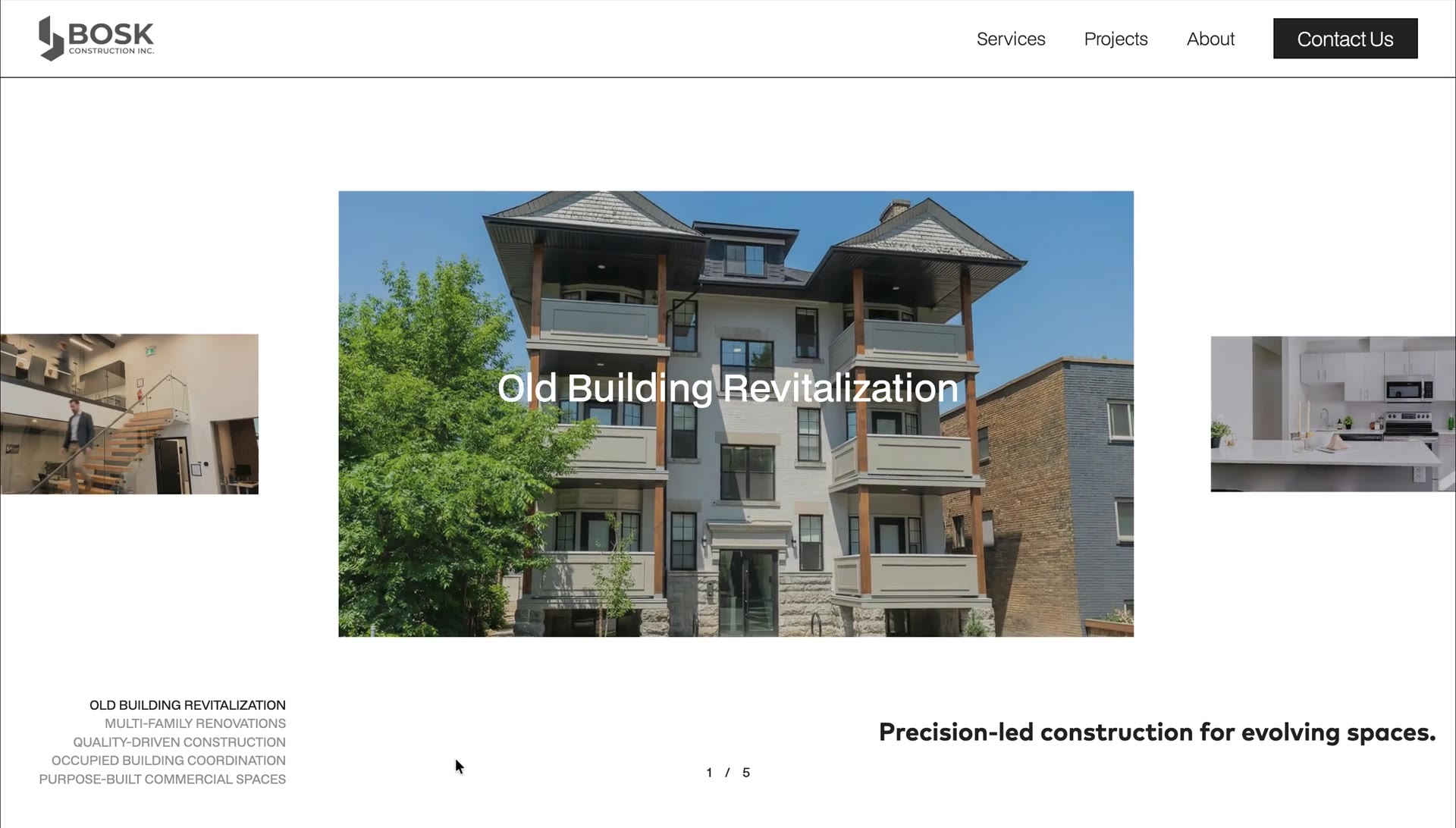
When Bosk Construction came to us, they had a capable team doing quality residential and commercial builds — but their website communicated almost none of that. Generic layouts, inconsistent photography, and no clear mechanism to turn a site visit into an inquiry.
We rebuilt the site around what their buyers actually needed to see. Project photography as the hero — not a stock image of scaffolding. A positioning statement that named the type of work and the geography. Licensing and credentials surfaced where buyers would look for them. A quote request form that asked three questions instead of twelve. And a mobile experience that loaded quickly enough to hold attention on a phone at a job site.
The result is a site that works the way a strong referral works: it shows the work, builds credibility quickly, and makes the next step obvious. See the full Bosk Construction project →
Five patterns that show up regularly — and each one costs leads:
⚠ Stock photography of equipment you don't own
Every major construction photo library has the same worker in a yellow hard hat reviewing blueprints with a clean hand. Buyers recognize it. Real project photos — even imperfect ones taken on a phone — are more persuasive than polished stock.
⚠ Vague service descriptions
"We do it all" is the line nobody believes. Named services with named project types and named clients convert better than open-ended language that tries to appeal to everyone.
⚠ No geographic specificity
If you work in a specific region, say so. Prospects searching for contractors in your area want confirmation you serve them — not a generic national-sounding homepage that could be anywhere.
⚠ Contact forms that are too demanding
Requiring a detailed project description before agreeing to a call filters out qualified leads unnecessarily. Gather basic info, then qualify on the discovery call.
⚠ Social proof that's stale or thin
A page called "Testimonials" with two quotes from 2018 doesn't move anyone. Current Google reviews, linked directly or embedded, carry far more weight — and they're continuously updated without any effort from you.
Building a construction brand online?
We design construction company websites that match the quality of the work — and convert the right buyers into inbound inquiries.
View Our Services →Question
Does a construction company really need a professional website?
Yes. In 2024, 75% of consumers always or regularly read online reviews when researching a business (BrightLocal), and most of that research happens through the company's website. For high-ticket services like construction — where a single project can run hundreds of thousands of dollars — the website is often the difference between a prospect reaching out and moving on to a competitor.
Question
What's the most important element of a construction company website?
Real project photography. Actual photos of completed work — not stock imagery — are the most direct proof of capability and quality. In 2002, the Stanford Web Credibility Project found that 46.1% of credibility judgments are driven by visual design. In construction, the visual content IS the product. Every project photo that's missing is a missed opportunity to build trust before a prospect calls.
Question
How long does a construction company website typically take to build?
A professionally designed construction website takes 6–10 weeks from kickoff to launch, depending on scope, revisions, and content readiness. The most common variable is photography — companies with a well-documented project portfolio tend to move faster, because the most persuasive content already exists. Companies without project photos sometimes need to schedule a shoot before the site can launch at full strength.
Question
Should a construction website focus on residential or commercial work?
Whichever audience you want more of. Residential and commercial buyers have different decision timelines, different trust signals, and different ways of evaluating a contractor. If you serve both, consider separate service pages with targeted copy. Blending both on a generic homepage with messaging that's vague enough to fit either tends to convert neither.
Construction companies compete on reputation and results. The problem is that reputation doesn't always reach the buyer first — your website does. A site that fails to communicate quality, show proven work, and make contact easy is losing leads to competitors whose builds might not even be as good as yours.
The gap between the quality of what you build and how that quality shows up online before the first conversation — that's the gap worth closing. If you want a site that actually reflects the caliber of your work, that's what we build.
Sources
BrightLocal, “Local Consumer Review Survey 2024,” 2024, retrieved 2026-05-24, brightlocal.com
Fogg, B.J. et al., Stanford Persuasive Technology Lab, “How Do People Evaluate a Web Site’s Credibility?” 2002 (n=2,684), credibility.stanford.edu
AGC of America, “Construction Industry Data,” Q1 2023, retrieved 2026-05-24, agc.org
Think with Google, “Understanding Consumers’ Local Search Behavior,” via Google Consumer Insights, retrieved 2026-05-24, thinkwithgoogle.com